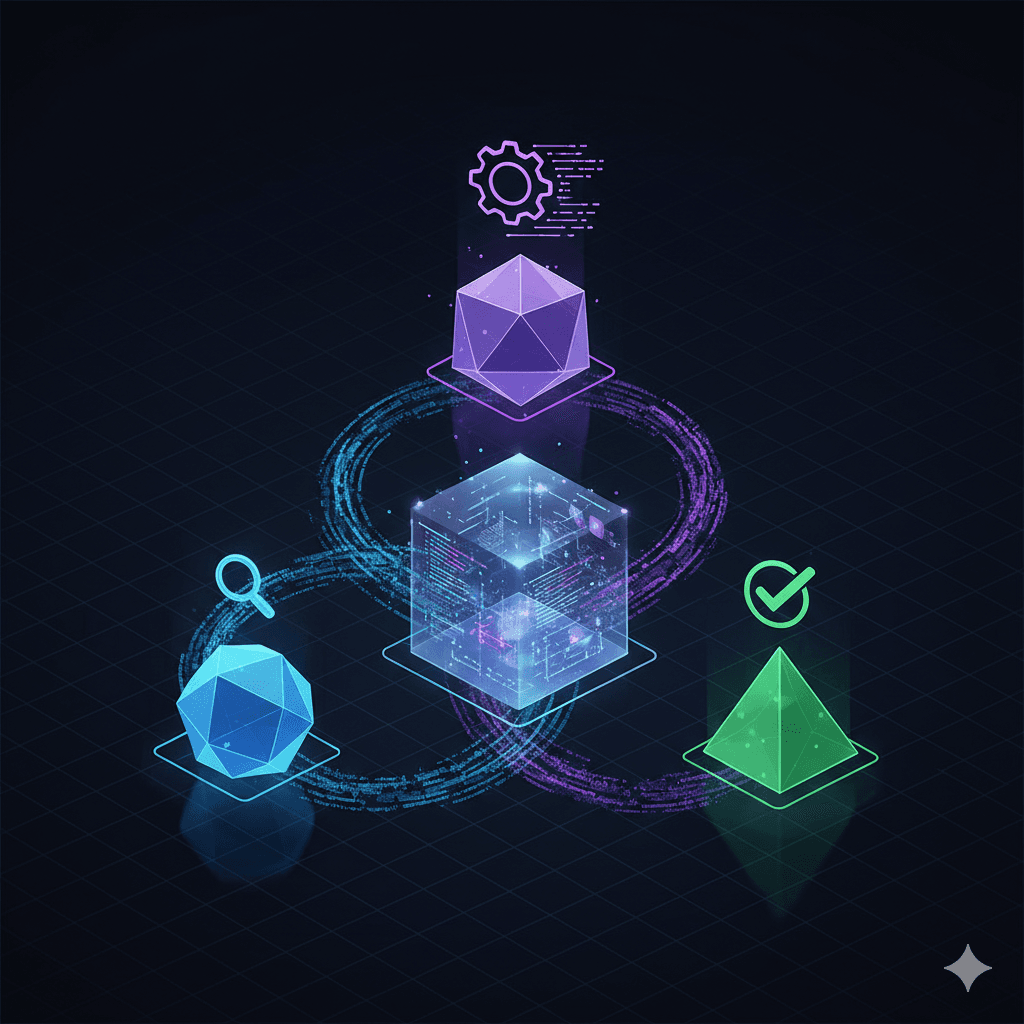
Every developer using AI assistants has experienced the same frustration: you ask a perfectly reasonable question, and the AI hallucinates an answer based on outdated documentation, invents APIs that don't exist, or suggests patterns that contradict your existing codebase.
The model isn't broken. The context is.
We built GemKit because the gap between powerful LLMs and productive AI-assisted development isn't intelligence—it's information. And closing that gap requires a fundamentally different approach to how we interact with AI coding assistants.
The Context Problem
When you use Gemini CLI (or any AI coding tool) directly, you face an impossible choice:
Option A: Minimal Context
The AI knows nothing about your project structure, existing patterns, or technical decisions. It generates generic code that requires significant adaptation.
Option B: Maximum Context
You dump your entire codebase into the context window. Token costs explode. Response quality actually decreases as the model struggles to identify what's relevant among thousands of lines of code.
Neither option works. What developers need is something in between: just enough context, delivered intelligently.
How GemKit Solves This
GemKit introduces three key innovations that transform how AI understands and works with your code:
1. Specialized Agents with Focused Scope
Instead of one generic AI trying to do everything, GemKit uses specialized agents with distinct roles:
| Agent | Focus | Scope |
|---|---|---|
| Researcher | Investigation and analysis | Documentation, patterns, best practices |
| Planner | Plan and strategy | Analyze, and create comprehensive implementation plans |
| Code-Executor | Implementation | Feature code, tests, integration |
| Tester | Quality assurance | Test generation, coverage analysis |
Each agent has a persona—a system prompt that shapes its behavior, priorities, and output format. The Researcher doesn't try to write code; it investigates. The Code-Executor doesn't speculate about patterns; it implements what's been planned.
Why this matters: Specialization reduces hallucination. An agent focused on testing won't suggest architectural changes. An agent focused on research won't write production code without verification.
2. Smart Context Loading
GemKit integrates with tools like repomix to generate intelligent context representations. Instead of dumping raw files, we create structured markdown that emphasizes:
- File structure and relationships
- Type definitions and interfaces
- Function signatures and documentation
- Import/export dependencies
The result is a compressed representation of your codebase that fits in the context window while preserving the information AI needs to generate accurate code.
Before (raw files): 50,000 tokens for a medium project After (smart context): 8,000 tokens with better accuracy
The agent receives:
- The auth service code (directly relevant)
- Type definitions (for type-safe implementation)
- Backend development patterns (from the skill)
- Your project's existing conventions (from context analysis)
3. Standardized Workflows
Repeatable results require repeatable processes. GemKit's workflow system ensures that complex tasks follow consistent patterns:
The /cook workflow orchestrates this automatically:
What happens internally:
- Research Phase: Researcher agent investigates JWT best practices, token storage, and security considerations
- Planning Phase: Planner agent creates an implementation plan with files to create/modify and code snippets
- Implementation Phase: Code-Executor writes the actual code following the plan
- Verification Phase: Tester agent generates tests and runs them
Each phase feeds into the next. The implementation isn't a guess—it's informed by research. The tests aren't boilerplate—they verify the actual implementation.
Our Vision: AI-Native Development
GemKit isn't just about making Gemini CLI easier to use. It's about enabling a fundamentally different approach to software development.
The Traditional Workflow
You conceive the solution in your head, translate it to code character by character, and the computer runs what you wrote.
AI-Assisted Workflow (Current State)
AI offers suggestions, but they're often wrong. You spend time fixing hallucinations, adapting generic code, and verifying that the AI didn't introduce bugs.
AI-Native Workflow (GemKit's Vision)
You describe what you want at a higher level. AI handles the implementation details. You review and refine. The computer runs verified code.
"The best code is the code you didn't have to write yourself, but still understand perfectly."
This isn't about replacing developers—it's about elevating them. When you're not typing boilerplate, you have bandwidth for architecture, design, and the genuinely creative aspects of software development.
What Makes GemKit Different
We're not the first AI coding tool, and we won't be the last. Here's what sets GemKit apart:
Open Source and Extensible
GemKit is MIT licensed. The entire toolkit—agents, skills, workflows—lives in your repository under .gemini/. You can:
- Customize agents for your team's standards
- Create skills with domain-specific knowledge
- Build workflows for your specific processes
- Share configurations across projects via npm packages
Provider Agnostic
While we're built on Gemini CLI, GemKit supports multiple AI providers:
Choose the best model for each task. Use Gemini for speed, Claude for complex reasoning, or mix providers within workflows.
Observable and Debuggable
AI workflows shouldn't be black boxes. GemKit includes the Agent Office—a visual dashboard that shows:
- Real-time agent activity
- Token consumption and costs
- Session history and replay
- Agent hierarchy and delegation
When something goes wrong, you can see exactly where and why.
Team-Ready
GemKit configurations are designed for version control and team sharing:
New team members get the same agents, skills, and workflows as everyone else.
The Journey Ahead
GemKit is evolving rapidly. Here's what we're building:
Short-term Roadmap
- More specialized agents: Security reviewer, performance optimizer, accessibility auditor
- Enhanced workflows: Custom workflow definition and sharing
- Better integrations: VS Code extension, GitHub Actions, CI/CD pipelines
Long-term Vision
- Autonomous operation: Agents that can work overnight on well-defined tasks
- Cross-project learning: Skills that improve based on usage patterns
- Team collaboration: Multi-user Agent Office with shared sessions
Join the Community
GemKit is built in the open, for the community. We believe AI-assisted development should be accessible, understandable, and improvable by everyone.
Ways to get involved:
- Try it:
npm install -g gemkit-cli && gk init - Star us: GitHub repository
- Contribute: Submit agents, skills, or workflow ideas
- Share feedback: Discord
- Follow updates: @gemkit on Twitter
The transition from traditional development to AI-native development is happening. GemKit is our contribution to making that transition smoother, more productive, and more enjoyable for developers everywhere.
Ready to start?
- Installation Guide - Get GemKit running in minutes
- Quick Start Tutorial - Your first agent session
- Agent Guide - Understanding specialized agents